






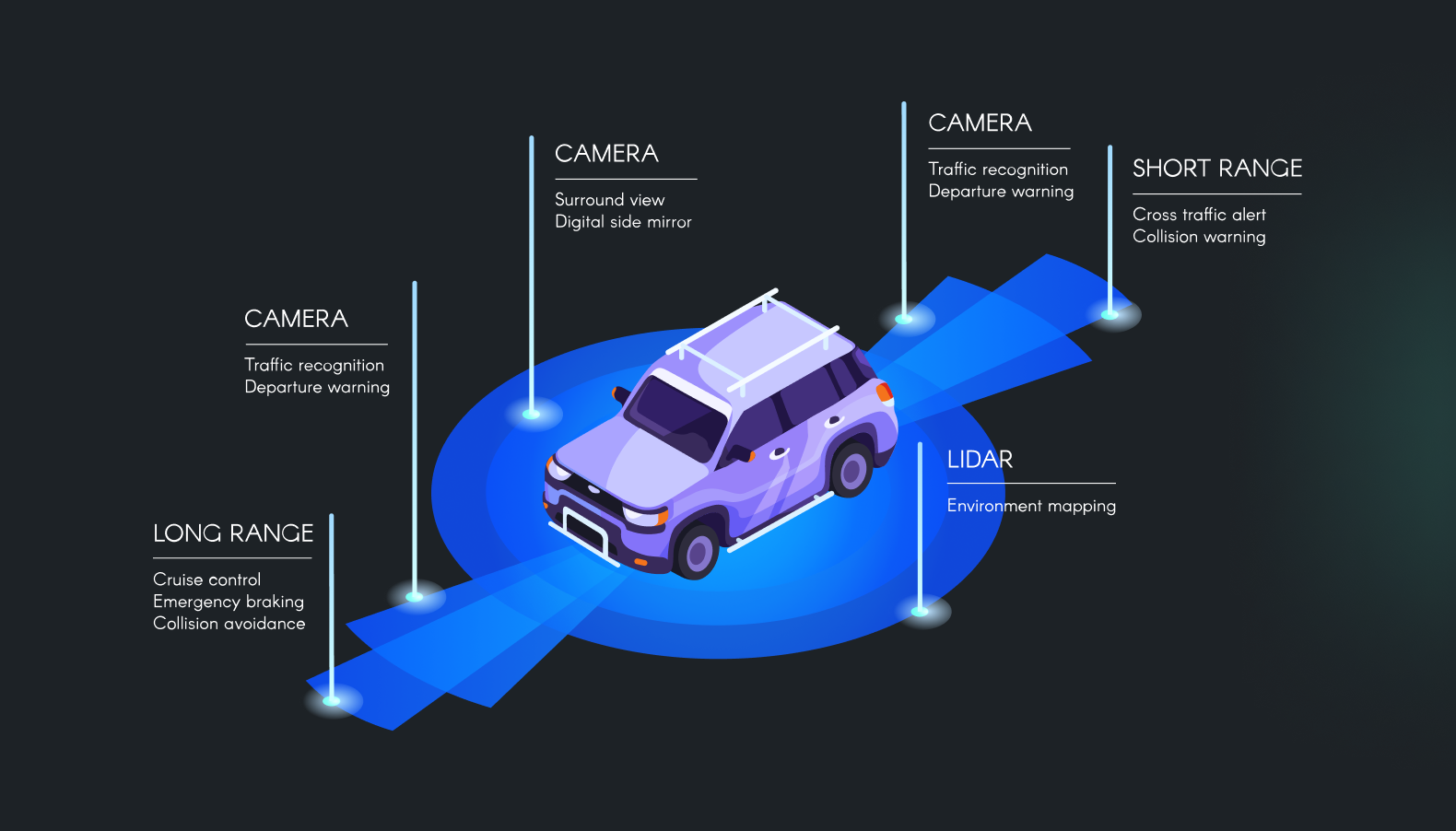
ADAS (Advanced Driver Assistance Systems)
Course Objectives
Outline the current landscape and industry need for ADAS in road vehicles.
Introduce fundamental sensing technologies: cameras, radar, LIDAR, and ultrasonic.
Present internationally accepted automation levels and their practical implications.
Detail operation principles behind sensor fusion, perception, and real-time control systems.
Identify ADAS components—including ECUs—and integration in automotive networks.
Describe major ADAS features and the user cases they address in transportation safety.
Teach calibration methodology and the diagnostics process for ADAS systems.
Enable hands-on training in removal, fitting, calibration, and repair of ADAS modules.
Provide practical exposure to ADAS function testing on both passenger and heavy vehicles.
Instill comprehensive safety, troubleshooting, and documentation skills for aftersales professionals.
Learning Outcomes
Define ADAS and its essential role in improving vehicle safety and automation.
Compare operation of camera, radar, LIDAR, and ultrasonic based sensing in automotive applications.
Interpret SAE-defined automation levels and assess their significance.
Explain sensor data acquisition, fusion, and control strategies in ADAS deployment.
Identify configuration of key components—cameras, radars, ECUs—within ADAS ecosystems.
List and explain the working principles of ACC, AEB, lane assist, park assist, BSD, and TLR.
Undertake step-by-step sensor calibration for accuracy and OEM compliance.
Demonstrate procedures for replacing and troubleshooting ADAS parts.
Validate correct function of ADAS using professional diagnostic tools and test protocols.
Produce structured documentation of ADAS diagnostics and ensure compliance with safety standards.
 Lessons: